Plinko Casino Australia: How the Slot Really Works
 Available in AU
- Plinko Slots: How the Classic Game Translates to Online Pokies
- Playing Plinko Online: Platforms, Features, and Player Experience
- Real‑Money Plinko Play: Stakes, Withdrawals, and Bonus Conditions
- Plinko Game Variations and Related Casino Games
- Australian Casino Landscape: Volume, Losses, and Pokie Distribution
- What Players Say: Reviews and Reputation of Plinko Casinos
- Understanding the Plinko Casino Brand in Australia
- Free Play Options: Demo Mode and Practice Plinko Games
- Cryptocurrency and Plinko: Legal Context and Technical Considerations
- Responsible Gaming and Compliance for Plinko Players
Plinko Slots: How the Classic Game Translates to Online Pokies
Plinko started life as a physical board: a disc dropped from the top, bouncing off pins in whatever direction gravity and geometry allowed, landing in a slot at the bottom that decided the payout. Nothing about that mechanic screamed "slot machine." No reels, no symbols, no paylines. And yet online pokies studios have spent years bolting that falling-disc idea onto slot architecture, and the result is now common enough on Australian-facing sites that it has its own shelf in the game lobby, separate from both classic pokies and drop-style crash games.
What actually happens when a developer does this is worth unpacking, because the "Plinko slot" label covers two genuinely different builds, and knowing which one you’re looking at changes how you should think about the game.
The physics is theatre, the outcome is code
In a physical Plinko board, the disc’s path is decided by real collisions — friction, angle, the exact pin it clips first. An online version has none of that. The bounce animation you see is rendered after the outcome already exists. Behind the graphics sits a Random Number Generator, the same category of software that decides where a reel stops or which card comes up in a digital blackjack shoe. The RNG produces a result, and only then does the front end draw a disc bouncing its way toward a slot that matches that predetermined outcome.
This is not a criticism of the format — it’s simply how every RNG-based casino game works, Plinko included. The industry runs independent testing agencies specifically to audit these generators, checking that the numbers they produce are statistically random and not weighted in ways the operator hasn’t disclosed. A Plinko slot that’s been through that audit process is functionally no different, in terms of fairness architecture, from a five-reel video pokie sitting next to it in the lobby. Same RNG core, same audit requirement, different skin.
Worth saying plainly: the "physics" marketing language — bounce, gravity, trajectory — is doing a job. It makes the drop feel mechanical, almost tangible, like something you could predict if you watched closely enough. You can’t. The disc’s path is cosmetic. I’ve sat through enough of these builds to notice that the bounce animation sometimes even ignores its own visual rules — a disc will "clip" a pin at an angle that shouldn’t send it where it goes — because the animation is fitting itself to an answer that already exists, not calculating anything in real time.

Two different things wearing one name
Search for a Plinko slot and you’ll land on titles that fall into two camps.
The first is a straight adaptation: a board, a disc, a set of multiplier slots at the bottom, sometimes dressed up with a theme — mythology being a favourite, hence titles built around gods and pantheons sitting somewhere in the mix of what’s on offer. These are closer to the original board game than to a pokie. There are no reels or symbols involved at all; the entire game is the drop.
The second camp takes the drop mechanic and folds it into something with actual reel or bonus-round structure underneath — a base game that plays like a conventional pokie, with a Plinko board appearing as a bonus feature, a way of resolving a free-spins multiplier, or a bonus buy pathway. In these builds, "Plinko" is a feature bolted onto a slot rather than the slot itself.
Both get marketed under the same umbrella term, and lobby categorisation on most sites doesn’t distinguish them clearly. That’s not an accident so much as a byproduct of how aggregators sort content — by keyword, not by mechanic. If you’re after the board-game purity, check whether there’s a base game with reels sitting underneath the drop before you commit time to it. If it has reels, it’s a slot with a Plinko feature. If it’s just a board, it’s the format in its more literal form.
Why the format caught on when it did
None of this happened in a vacuum. Online casino gaming broadly has ridden a wave of technological integration — better streaming, faster mobile rendering, more sophisticated RNG certification processes — that’s made it easier for studios to prototype and ship games that would have been technically awkward a decade ago. A convincing physics-style bounce animation running smoothly on a mid-range phone is a rendering problem that simply wasn’t solved cheaply before. Now it is, and that’s part of why drop-mechanic games have proliferated across pokies libraries rather than staying a novelty.
There’s also a simpler explanation sitting underneath the technical one: Plinko’s appeal is legibility. A five-reel pokie with cascading wilds and a dozen bonus conditions takes real effort to understand before you know what you’re looking at. A Plinko board doesn’t. Drop, bounce, land, see the multiplier. The entire game state is visible on one screen, and the outcome resolves in seconds. For players who want the pace of a slot without the rules overhead of one, that simplicity is the product.
What the volume of pokies play in Australia tells you about appetite for this
Australians are, by most measures, unusually heavy players of gaming machines generally. In the 2020–2021 financial year, betting through electronic gaming machines nationally ran to almost AUD$150 billion, with total player losses landing around AUD$12 billion for that same period. Put another way: Australia holds about 3% of the entire world’s pub and club poker machines while accounting for roughly 0.3% of the world’s population — a concentration that’s hard to find matched anywhere else.
That context matters for a Plinko slot discussion specifically because it explains the appetite that formats like this are built to satisfy. A market this saturated with machine-based play, where the pokie is already the dominant leisure-gambling format, is exactly the environment where a simplified, fast-resolving variant on the same theme finds an audience quickly. Plinko didn’t need to build a market from nothing; it slotted into one that already existed at scale.
Demo mode and what it actually shows you
Most Plinko slots, in either of the two structural forms described above, come with a demo mode running on virtual funds rather than real balance. This is standard across slot games generally, not something specific to the Plinko category, but it’s particularly useful here because demo play lets you see the RNG’s output distribution over a run of drops without financial stakes attached. Watching a hundred drops in demo mode won’t tell you anything about a specific future outcome — the RNG doesn’t have memory or patterns to detect — but it will show you what the multiplier spread and volatility of a specific title actually look like in practice, which is more informative than anything the promotional material for the game tends to say outright.
That’s really the honest pitch for a Plinko slot: it’s a slot mechanic wearing a game everyone already understands intuitively, running on the same certified randomness as everything else in the lobby, with the "physics" doing atmosphere rather than arithmetic.
Demo mode uses the same RNG as real‑money play, so it shows the game’s volatility but does not eliminate the underlying randomness.
Playing Plinko Online: Platforms, Features, and Player Experience
Ask about "golden Plinko" or which casino runs the best version and the honest answer is that there isn’t a domestic answer at all. No Australian-licensed operator can offer Plinko, or any online casino game, to residents. The Interactive Gambling Act 2001 is the piece of legislation that settles this — a Commonwealth law built around harm minimisation, and it draws a hard line between wagering products it permits and casino-style products it doesn’t. Plinko sits on the wrong side of that line. What exists instead is a landscape of offshore platforms, and the way people talk about "the online casino with Plinko" usually means one operating from a foreign licence, not an Australian one.
That distinction matters more than most players realise, because it changes what the word "platform" even means here. On a licensed domestic wagering site, platform choice is mostly cosmetic — same rules, same protections, different skin. Offshore, platform choice is the whole risk profile. Different operators run different back-end providers, different payment rails, different dispute processes, and none of it is checked by the Australian Communications and Media Authority, because ACMA’s role stops at enforcement against the operators, not certification of them for local play.

RNG versions versus live-dealer versions
Once you’re looking at an offshore Plinko offering, the split that actually shapes the experience is RNG-based versus live-dealer. Most Plinko products are RNG: a ball drop simulated by a random number generator, resolved instantly, no human involved. It’s fast, it’s the same format the previous section covered as an online pokie variant, and it scales to any stake size the site allows.
Live-dealer Plinko is different in kind, not just in presentation. These are streamed in real time with a professional host running the session, and the appeal is watching an actual physical or physically-modelled drop rather than trusting a hidden algorithm. I’ve sat through both for long enough sessions to notice the difference isn’t really about fairness — a properly audited RNG is not less fair than a camera on a real board — it’s about pacing. Live formats run on the dealer’s clock. RNG formats run on yours. Anyone chasing "plinko live casino" specifically is usually chasing that slower, hosted rhythm, not a better outcome.
What the player interface actually looks like
Strip away the branding and most Plinko interfaces online share the same skeleton:
- A staking panel, letting the player set a bet before each drop.
- A risk or volatility toggle, which changes how the peg board pays out without changing the drop mechanic itself.
- A drop trigger, manual or automated, that releases the ball or its RNG equivalent.
- A results ledger, showing recent drops — present on nearly every version I’ve tried, because it’s cheap to build and it keeps the screen from feeling empty between rounds.
Where sites differ is in how much they layer on top of that skeleton — statistics panels, sound design, auto-play sequences. None of it changes the underlying math. It changes how long you sit in front of it.
Account setup and who’s actually allowed in
Getting into any of these platforms, live or RNG, runs through the same gate regardless of which operator you land on. Registration asks for identity details, and the site is expected to confirm two things before letting anyone past the demo screen: that the player is at least 18, and that they are an Australian resident. Those two conditions aren’t a platform feature that varies by operator — they’re baseline requirements tied to how gambling is meant to be gated everywhere, and a site skipping them is a site worth walking away from, not a site being generous.
Bonus prompts tend to show up early in the account flow — deposit matches, free spins, sign-up credit, whatever the current promotion is called. Every version of it comes wrapped in conditions: wagering requirements, restrictions on which games count toward clearing the bonus, and expiry windows on the offer itself. I’ve seen "welcome offer" attached to terms that made the bonus functionally unplayable, and none of that shows up on the button you click to claim it — it shows up in the terms page nobody opens first. Read that page first, not last.
Why the number of platforms keeps growing
One thing worth naming plainly: the pool of sites offering games like Plinko, including ones marketing toward Australians, has been getting larger. That’s the shape of the online casino sector more broadly right now — one industry review tracking this growth put it down to widening use of streaming and payment technology making new platforms cheaper to launch. Take the direction of the trend seriously, take any specific number attached to it from a single affiliate source with a grain of salt.
More platforms doesn’t mean more oversight. It means more variation in how strictly any given site actually applies the age and residency checks it claims to have, and more variation in how clearly it discloses bonus terms before asking for a deposit. The player experience on any Plinko platform is really an experience of that operator’s specific choices — not a standard set by the game itself, and not one enforced by an Australian regulator, because there isn’t one in a position to enforce it here.
Real‑Money Plinko Play: Stakes, Withdrawals, and Bonus Conditions
Before anything else, the legal position has to be stated plainly, because it changes what "real-money play" actually means on this market. There are no domestically licensed real-money online casino operators available to Australian players. The Interactive Gambling Act 2001 prohibits online casino-style games — slots, poker, blackjack, roulette, and Plinko falls into that same bracket — at the federal level. One older source cites the Interactive Gambling Act 1997 as the relevant prohibition rather than the 2001 Act; the two dates turn up in different places and I won’t pretend one is definitively correct. What both versions agree on is the outcome: no operator can hold an Australian licence to run this for cash, and none does.
Illegal gambling risk
Playing Plinko for real money on offshore sites is not prohibited for the player, but the operators are breaking Australian law, meaning there is no local recourse if something goes wrong.
What the law does not do is criminalise the player. It targets operators, not individuals, so an Australian sitting down at an offshore-licensed site and putting real money on a Plinko board isn’t committing an offence. That’s a narrow distinction and it’s worth being exact about it, because "not illegal for you" and "legal" are different claims. The first is true. The second isn’t, not domestically, not for this game type. Sports betting is the one corner of online gambling that’s actually licensed under state and territory frameworks — Plinko, and casino games generally, sit outside that.
Stakes and how they’re actually set
Because there’s no local licensing body signing off on this game, there’s no regulator publishing an approved stake range for it either. Betting limits on any given Plinko board are whatever the operator running it has decided, full stop — set offshore, under whatever licence that operator holds in its own jurisdiction, not under anything Australian. I’ve seen this presented as "flexible staking for every bankroll." True enough. It’s also true because nobody local is checking.
Withdrawals: the part that actually tests an operator
Deposits are the easy half of any real-money relationship with an operator — it’s the withdrawal that shows what the terms were actually for. A few things hold regardless of which offshore operator is involved:
- Identity verification is standard before a withdrawal clears — expect to submit government-issued ID, and expect this to happen at the point you try to take money out, not before.
- Wagering conditions attached to any bonus balance need to be cleared before that balance, or winnings from it, become withdrawable.
- Payment method matters. Credit cards and digital currencies are not something a compliant operator should be accepting for deposits or bets under the standards this market expects — if a site takes either without hesitation, that’s a signal about which rules it’s actually following, and it’s not a local one.
None of this is enforced by an Australian regulator, because none has jurisdiction here. It’s enforced, if at all, by whichever authority licensed the operator — and by the operator’s own terms, which is a different thing from law.
Bonus wagering — read it before you claim it, not after
"Bonus" is doing a lot of work in that phrase. What it means in practice is a wagering requirement — a multiple of the bonus amount, sometimes the deposit too, that has to be bet through before any of it can be withdrawn — plus game restrictions on which titles count toward that requirement, plus an expiry window. The specific multiples and time limits are set entirely by the individual operator’s terms; there’s no standard figure I can point to that applies across the board, and I’d rather say that plainly than invent a number that sounds authoritative.
What should be non-negotiable, wherever you’re playing, is that the wagering conditions are disclosed clearly before you accept the bonus, not buried in a terms page you find after you’ve already tried to cash out. A site that shows the wagering requirement up front is behaving the way it’s supposed to. A site that makes you dig for it afterward is not.
The real cost, stated once
Electronic gaming machines cost Australian players an average of AUD$608 per capita in FY 2020–2021. That figure is about pokies specifically, not Plinko, and I’m not going to stretch it to cover a game it wasn’t measured on. What it does establish is the order of magnitude of loss this market already produces through machines that are, mechanically, close cousins of what a Plinko board does — a ball drop replacing a reel spin, the same fixed house edge underneath.
Real money on a Plinko board means: an operator you have no domestic legal recourse against, terms set by a jurisdiction that isn’t this one, and a withdrawal process that will ask for your ID at the exact moment you’re hoping it won’t. That’s not a warning dressed up as advice. It’s just what "real-money" means once you take the marketing language off it.

Plinko Game Variations and Related Casino Games
Plinko itself doesn’t have much room to vary — a ball, a board of pegs, a set of multipliers at the bottom. Where it gets interesting is in how sites dress it up: different board shapes, different multiplier layouts, sometimes a themed skin bolted onto the same underlying drop mechanic. Strip away the graphics and the math engine underneath is doing the same job every time. I’ve seen operators call a re-skinned version something else entirely, as if a new background image counts as a new game. It doesn’t. The physics — or the RNG standing in for physics — stays put.
That’s worth knowing before comparing Plinko to what else sits in a typical game library, because the category habits differ more than the individual titles do.
Where Plinko sits next to card games
Card games such as poker, baccarat, and blackjack turn up online in plenty of variations — different rule sets, different side bets, different table formats. What they share with Plinko is randomness at the core, but the resemblance stops there. Card games reward reading the game state: pot odds, dealer upcards, remaining deck composition. Plinko has no state to read. Every drop starts fresh. Anyone coming from blackjack looking for a "system" in Plinko is applying a skill-game habit to a pure-chance mechanic, and it won’t transfer.
Where it sits next to table games
Table games available online — roulette, craps, Pai Gow, Sic Bo — are a closer cousin. Roulette in particular is the honest comparison: a ball, a fixed set of outcomes, a payout table that doesn’t care what happened last spin. Craps and Sic Bo add dice instead of balls but run on the same logic. Plinko is really a simplified, visually gamified version of that same idea — drop something random, land on a number, get paid according to where it landed. The "game" is presentation. The math is roulette wearing a different coat.
Where it sits next to slots
Slot games are the dominant category on most Australian online casino sites, where they’re generally known as online pokies — and this is the family Plinko gets marketed alongside most often, even though it isn’t structurally a slot. Pokies have reels, paylines, bonus rounds triggered by symbol combinations. Plinko has none of that. What links them commercially is the interface: press a button, watch an animation, get an instant result, repeat. That single-action rhythm is why sites file Plinko under "instant games" or slide it into the pokies lobby rather than giving it its own section.
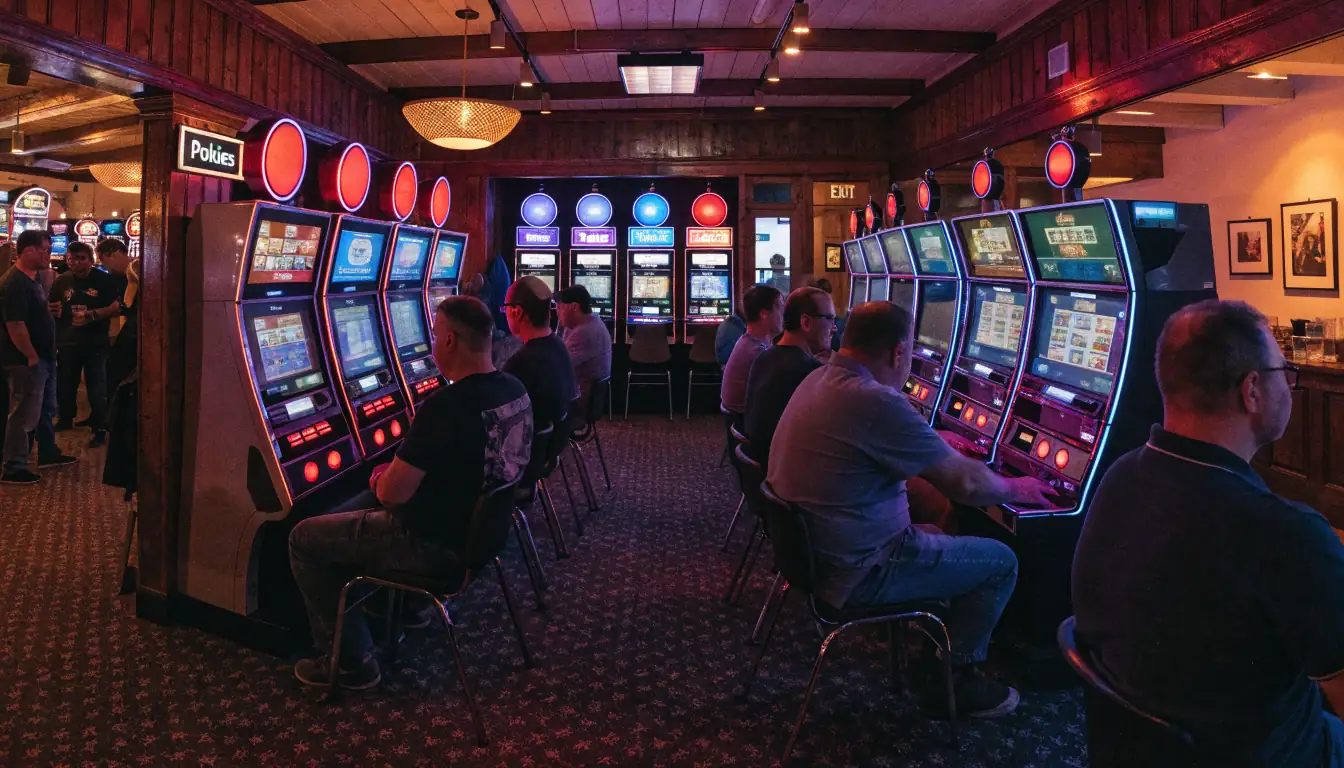
It’s a useful comparison for anyone who grew up around physical pokies too. New South Wales alone has somewhere in the order of 95,800 poker machines, with the Central Coast region contributing close to 4,672 of them — a slice of a much larger national footprint. That density shaped what "a quick game" means to a lot of Australian players: sit down, press a button, walk away in a few minutes if it doesn’t land. Plinko fits that exact rhythm online, just with a ball instead of a reel.
None of this makes Plinko a card game, a table game, or a slot. It borrows the payout logic of roulette, the pacing of a pokie, and none of the decision points that make poker or blackjack genuinely different games session to session. Useful to know before staking anything on it — which is where the real-money side of the picture actually gets decided.
Australian Casino Landscape: Volume, Losses, and Pokie Distribution
Numbers put context around anything with the word "casino" in Australia. In the 2020‑2021 financial year, Australians placed bets worth almost AUD$150 billion through electronic gaming machines. Of that, AUD$12 billion never came back — it stayed with the machines. That’s not turnover, that’s loss. The distinction matters, because "volume" is the number an operator likes to quote, and "loss" is the number a household actually feels.
Pokies aren’t spread evenly. Some regions carry a disproportionate share of the machines, and the density tells its own story about where the money actually gets spent. Take the Central Coast of New South Wales. Gosford has roughly 1,928 pokies — about one machine for every 71 adults in the area. Wyong runs denser again: around 2,608 machines, close to one per 47 adults. That’s not a shortage of supply anywhere near either town.
I’ve sat across the table from people who ran these floors, and the maths behind machine placement is never about convenience for the player. It’s about proximity. A venue doesn’t need everyone in town gambling — it needs enough of them close enough, often enough.
Why this matters for Plinko
Plinko itself isn’t a pokie, and it isn’t licensed for real‑money play by any Australian regulator — that’s a separate legal question covered elsewhere in this piece. But the numbers above explain the appetite it’s stepping into. A market that moves this much volume through physical machines, with losses this concentrated, is a market primed to notice a new game format the moment it turns up online, regardless of where it’s actually hosted or licensed.
The "growth" language you’ll see attached to online casino offerings generally, including games like Plinko, tends to come from industry overviews rather than regulators — one such review noted that the number of online casino sites available to Australians, among others globally, keeps climbing. Take that as an industry observation, not a market fact with a hard number behind it. Nobody publishes a verified count.
What’s verifiable is the physical footprint: nearly 96,000 machines in New South Wales alone, a national share of the world’s poker machines wildly out of proportion to population, and specific towns where the machine count outpaces anything resembling everyday need. That’s the backdrop Plinko’s popularity gets measured against — not a blank market, a saturated one.

What Players Say: Reviews and Reputation of Plinko Casinos
Read enough player forums and the pattern repeats itself: nobody writes a paragraph about the game being fun. They write about withdrawals that took too long, support that went quiet, or a bonus that turned out to mean something different from what the banner promised. Reviews of Plinko titles specifically tend to split into two piles — people commenting on the drop mechanics and volatility, and people commenting on the operator wrapped around the game. The second pile is longer, and it’s the one worth reading closely.
I’ve noticed reviewers rarely mention the RNG unless something felt off. That’s the nature of an audited system doing its job quietly — Australian-facing operators generally run software that’s checked by independent testing agencies, and when that auditing is real, there’s nothing dramatic to report. Silence about fairness is, oddly, a decent signal. Loud complaints about a game feeling "rigged" after a losing streak are noise; a pattern of complaints about withheld winnings is not.
Reputation, in this market, isn’t built on a licence badge in the footer. There’s no domestic regulator issuing casino licences here — oversight of online gambling sits with the Australian Communications and Media Authority, and its role is enforcement against unlawful provision, not certification of operators as "approved." So when a review says an operator is "fully licensed and regulated," ask regulated by whom, and for what. Often the answer is a jurisdiction with no bearing on how a complaint from an Australian player actually gets resolved.
What separates a trustworthy Plinko listing from a forgettable one usually comes down to specifics: named audit bodies, clear complaint handling, consistent payout behaviour reported over time rather than a single glowing post. Vague praise.
Worth nothing on its own.
Understanding the Plinko Casino Brand in Australia
Before you drop a single ball on a plinko board, it’s worth knowing what each casino actually offers in terms of bonuses, payout speed and licensing — the details below focus on exactly that.
Bonus: up to A$750 + 50 jackpot spins, 35x wagering · Payout speed: crypto ~90 minutes, fiat 1-5 days · Min. deposit: A$30 Offers a welcome package up to A$750 plus 50 jackpot spins with 35x wagering, and stands out for fast crypto payouts of around 90 minutes alongside a low A$30 minimum deposit.
License: Curacao Gaming Control Board OGL/2023/174/0082 (Dama N.V.) · Bonus: up to A$5,000 + 300 free spins across 4 deposits Licensed by the Curacao Gaming Control Board under Dama N.V., with a sizeable welcome offer of up to A$5,000 and 300 free spins spread across four deposits.
License: Curacao Gaming Control Board OGL/2023/176/0095 (Hollycorn N.V.) · Bonus: up to A$11,000 + 300 free spins (code NEO100) Operating under a Curacao Gaming Control Board license via Hollycorn N.V., it backs this with a large bonus of up to A$11,000 plus 300 free spins redeemable with a code.
License: Curacao Gaming Control Board OGL/2023/176/0095 (Hollycorn N.V.) · Bonus: 100% up to A$10,000 + 100 free spins Licensed by the Curacao Gaming Control Board through Hollycorn N.V., with a straightforward 100% bonus up to A$10,000 and 100 free spins on offer.
Bonus: up to A$7,500 + 550 free spins across 10 deposits, 50x wagering · Payout speed: crypto under 1 hour, PayID 1-3 business days · Min. deposit: A$20 (A$30 to qualify for the bonus) Provides an extensive bonus of up to A$7,500 plus 550 free spins over ten deposits at 50x wagering, with quick crypto withdrawals under an hour and PayID processed within a few business days; a A$30 deposit is needed to qualify for the bonus.
License: Curacao Gaming Control Board (TechSolutions Group N.V.) · Bonus: 100% up to A$250 + 100 free spins (1st deposit) Holds a Curacao Gaming Control Board license under TechSolutions Group N.V., offering a first-deposit bonus of 100% up to A$250 plus 100 free spins.
License: Curacao eGaming (Roby Games Ltd) · Bonus: 100% up to A$750 + 200 free spins Licensed under Curacao eGaming via Roby Games Ltd, with a welcome bonus matching deposits 100% up to A$750 alongside 200 free spins.
License: Curacao eGaming (Dama N.V.) · Bonus: up to A$10,000 + 180 free spins, 40x wagering Operating under a Curacao eGaming license through Dama N.V., it offers a bonus up to A$10,000 with 180 free spins at 40x wagering.
Bonus: 100% up to A$750 + 200 free spins, 35x wagering · Payout speed: crypto 30-120 minutes, fiat 24-72 hours · Min. deposit: A$30 Features a 100% bonus up to A$750 with 200 free spins at 35x wagering, paired with speedy crypto payouts within 30-120 minutes and a A$30 minimum deposit.
License: Curacao OGL/2024/1335/0780 · Bonus: up to A$1,000 + 150 free spins, wager-free · Min. deposit: EUR 20 Holds a Curacao license (OGL/2024/1335/0780) and offers a wager-free bonus up to A$1,000 plus 150 free spins, with a minimum deposit set at EUR 20.
"Plinko casino" is a branding shorthand, not a licence category. There’s no separate regulatory class for it — no operator holds a permit specifically to run Plinko-branded products. What sites are doing when they build a whole identity around the name is borrowing recognition from a single game shape and stretching it over a catalogue that’s mostly the same online pokies you’d find under any other banner.
That matters because the pitch of a "Plinko casino" implies specialisation — as if the operator built something bespoke around the drop-and-bounce mechanic. In practice, the Plinko title on the front page usually sits above a games list where slots are still the dominant category, same as everywhere else. The branding is a hook, not a different business model underneath it.
I’ve seen this pattern before it had a name: a casino builds its whole front-page identity around one trending mechanic because it’s cheap to market and easy to demo, then routes traffic into the standard slot catalogue once someone’s signed up. Nothing dishonest about it exactly — the game is there, playable, often with a demo mode running on virtual funds like the rest of the slot library. But "Plinko casino" as a label tells you about the marketing angle, not about licensing, fairness standards, or anything that actually protects a player.
Worth remembering when a site’s whole name and design revolve around one game: the branding is the product being sold to you before you’ve placed a bet. The gambling underneath it isn’t branded at all.
Free Play Options: Demo Mode and Practice Plinko Games
Demo mode is where most people actually meet Plinko for the first time. No deposit, no account balance at risk — just virtual credits that reset or top up whenever you reload the page. The board looks and behaves exactly the same as the paid version: same drop mechanic, same peg layout, same underlying software generating each outcome.
That last part matters. The RNG driving a demo round is the same audited system running behind real-money play. Independent testing agencies check these RNGs on a regular basis, so a free session tells you something true about how the game behaves — the drop pattern, the frequency of hitting different multiplier slots, the general "feel" of variance. What it can’t tell you is anything about your own money, because there isn’t any.
That’s the actual difference, and it’s worth stating plainly: demo mode removes financial risk, not randomness. Some players use it for exactly one purpose — figuring out staking patterns before switching to real bets. Others just play it as a game, full stop, with no intention of ever depositing.
Practice credits.
Nothing more, nothing less.
Where demo mode falls short is anything involving withdrawals, wagering conditions, or bonus terms — those only exist once real funds are on the table, and that’s a separate conversation entirely.
Cryptocurrency and Plinko: Legal Context and Technical Considerations
Crypto casino Plinko gets marketed as some kind of loophole — a way around banking restrictions because Bitcoin or Ethereum "isn’t really money" in the eyes of regulators. It is. The Interactive Gambling Act 2001 doesn’t carve out an exception for digital currency. It prohibits online casino-style games, Plinko included, regardless of what settles the bet.
What changes with crypto isn’t the legal standing, it’s the plumbing. A crypto Plinko script runs on the same RNG logic as any other version — a ball drops, physics or a pseudo-random seed decides where it lands, and the payout table does the rest. The currency wrapped around that outcome is separate from the outcome itself.
I’ve seen crypto framed as the "discreet" option. It isn’t discretion, it’s just a different rail.
None of this creates a licensed pathway. There isn’t one, in any currency.
Responsible Gaming and Compliance for Plinko Players
Every Plinko site worth touching states two things clearly before you deposit a cent: minimum age and residency. Age is set at 18 across Australian online gambling, no exceptions, no "parental consent" workaround some forums like to invent. Residency matters too — the platform needs to know where you’re playing from, and "I have a mate overseas" isn’t a compliance strategy.
Here’s what nobody’s regulating locally: there’s no Australian licence for online Plinko, and no domestic body issuing one. Oversight of interactive gambling generally sits with the Australian Communications and Media Authority, but that’s enforcement against operators, not a stamp of approval you can look up on a register. There isn’t one to check.
So "responsible gaming" for a Plinko player looks less like reading fine print and more like self-management: deposit caps you set yourself, breaks you actually take, self-exclusion if the drops stop being fun.
No regulator is watching your session. You are.
Can I play online pokies for free?
Yes, many slot games are available in demo mode with virtual funds, so you can try pokies without risking real money.
How can I verify if a gambling operator is legal?
Online casino regulation in Australia is overseen by the Australian Communications and Media Authority (ACMA), and the Interactive Gambling Act 2001 prohibits online casino games being offered to Australian residents — note there are no domestically licensed real-money online casinos. It is not illegal for individuals to play at offshore-licensed casinos, as the law targets operators, not players, so check the operator’s offshore licence (for example from a recognised gaming authority) before playing.
How do online Plinko and pokies games stay fair?
They use Random Number Generators (RNGs) to determine outcomes, and these generators are regularly audited by independent testing agencies to confirm the results are genuinely random. In Plinko games, the bouncing disc animation is purely visual — the outcome is decided by the RNG before the animation plays.
Created by the ”Casino Rankings Info” editorial team.