
Casino Sites That Accept Paysafecard in Australia
- Australian Paysafecard Availability and Legal Age
- How Paysafecard Works as a Payment Method in Australian Casinos
- Making a Paysafecard Deposit: Process, Speed and Fees
- Top Offshore Casinos Accepting Paysafecard in Australia (2026)
- Online Pokies You Can Play with Paysafecard
- Paysafecard Slots: Limits, Wagering and Bonus Conditions
- Game Types Supported by Paysafecard: Pokies, Poker and Live Dealers
- Instant Withdrawal Options for Paysafecard‑Funded Accounts
- Withdrawing Money After a Paysafecard Deposit
- Can You Use Paysafecard at Australian Online Casinos? FAQ
Australian Paysafecard Availability and Legal Age
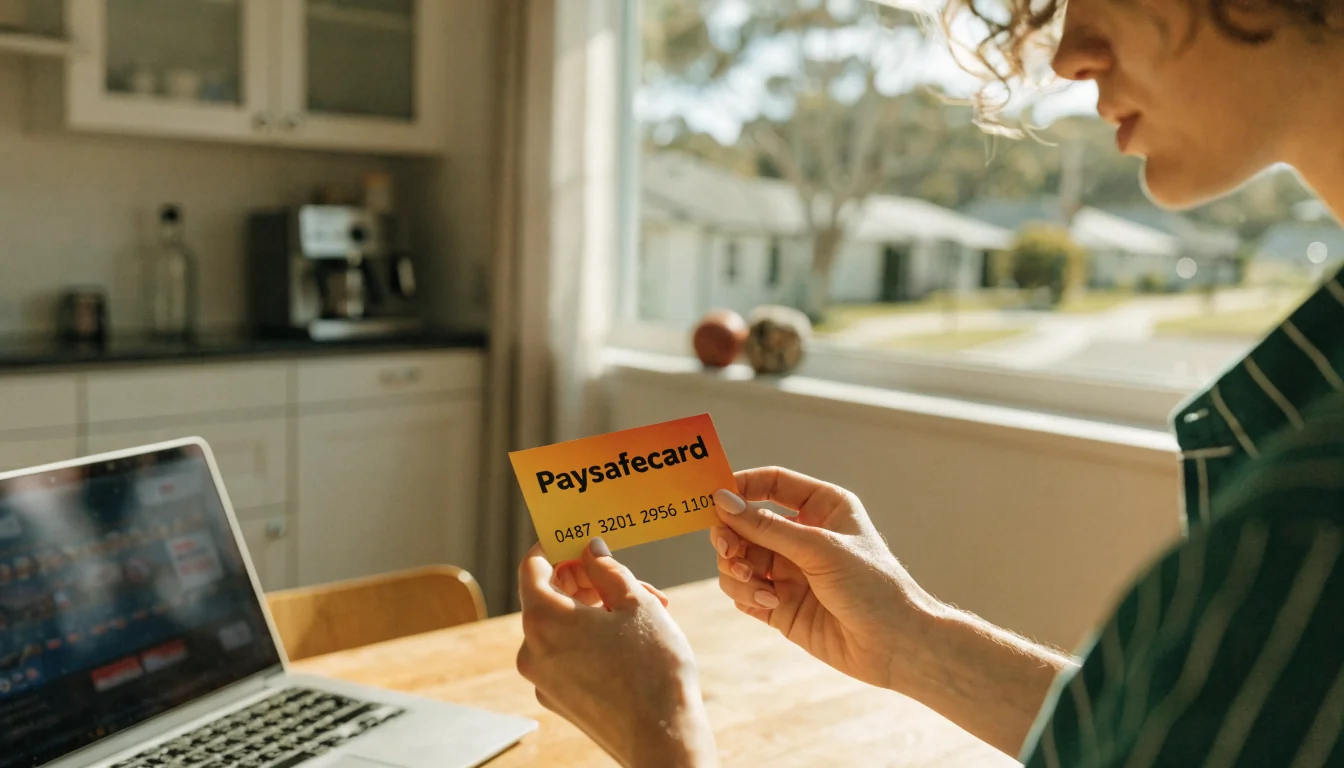
Buying a Paysafecard voucher in Australia doesn’t require a bank account or a card. Vouchers are sold over the counter at 7-Eleven, Coles Express, Australia Post outlets and most newsagents. You hand over cash, get a PIN, and that PIN is your balance. No app, no sign-up at the till.
That simplicity is exactly why it ended up tied to gambling sites in the first place — cash in, no paper trail back to a bank statement. Worth knowing before the "how it works" part, because the purchase step and the deposit step are two different things handled by two different systems.
Age matters here in a way the voucher itself doesn’t enforce. The minimum legal gambling age in Australia is 18, full stop. A Paysafecard voucher doesn’t check who’s using it — the retailer selling it does, at least in theory, the same way it would for a scratch ticket. What happens after purchase is on the casino, not the shop counter.
How Paysafecard Works as a Payment Method in Australian Casinos
A voucher, a PIN, a balance credited to the casino account — that’s the whole mechanism. No card number, no bank details attached to the transaction. Paysafecard was built this way for a reason: it moves money in one direction only.

That direction is in. Whatever a casino calls it — "instant funding," "prepaid deposit," "cash voucher payment" — the function underneath never changes. Winnings don’t go back out the same door they came in through. A Paysafecard casino payment method works purely as a deposit tool, and no operator, however it markets the option, can route a withdrawal onto the voucher itself.
The other detail that matters more than the branding: none of this sits under Australian oversight. Paysafecard isn’t licensed here as a gambling payment channel, and the sites accepting it aren’t licensed here either. Which casino accepts Paysafecard is really a question about offshore operators running on their own terms, not on Australian consumer protection rules.
Worth knowing before the deposit screen, not after.
Making a Paysafecard Deposit: Process, Speed and Fees
The mechanics behind a Paysafecard deposit at an offshore casino are simpler than the marketing pages suggest, and also less direct. The voucher code never goes straight into a casino’s ledger. It passes through a payment processor first — names like UTORG, Chain Valley or EazyPayz show up repeatedly in the checkout flow, sitting between the player and the casino’s cashier system. This is the part most deposit guides skip over.
The actual steps
- Log into the casino account and open the cashier or banking section.
- Select Paysafecard as the deposit method.
- Enter the 16‑digit PIN from the voucher, or log into a My Paysafecard account if the PIN has already been loaded there.
- The request gets handed off to a third‑party processor, which converts and routes the funds to the casino.
- The balance appears in the casino wallet.
That handoff to a processor is not optional and it is not disclosed. A player entering a PIN sees a single form; behind it, the transaction is being cleared by a payment company that has its own relationship with the casino, not with Paysafecard directly. Worth knowing before assuming the casino itself "accepts" the voucher in any direct sense — it accepts what the processor forwards.
Speed
Credit time is one of the few genuine strengths of the method. Deposits are typically instant, landing in the casino account within a minute of the PIN being submitted. There’s no bank cut‑off, no pending status, no waiting for a card issuer to clear the charge. For a deposit‑only tool, this is the whole point — get money onto the balance fast enough that a session doesn’t stall at the cashier.
That speed doesn’t carry over to the other side of the transaction. Getting money out uses entirely different rails, covered separately — nothing here should be read as a comment on withdrawal timing.
Deposits are typically instant, appearing within a minute after the PIN is submitted.
The dormancy fee, and where the sources disagree
Unused voucher balances aren’t free to sit there indefinitely. Paysafecard applies a monthly fee of A$4 to a voucher once it’s gone unused for a period — this is where the paperwork gets inconsistent. Some documentation ties the fee to the first month of inactivity; other versions describe it kicking in only after six months of no activity. Both figures come from material that claims to describe the same policy, and I’m not going to pretend one is obviously right. The number that matters — A$4 per month — is consistent. The trigger point is not. Anyone holding a voucher rather than spending it should check the terms printed on the voucher itself or in the My Paysafecard account rather than take either timeline as fixed.
Practically, this argues against buying a voucher larger than what’s going to be deposited in the near term. A $50 PIN sitting half‑spent for months quietly loses value to a fee that most players don’t think about until they check the balance and find it smaller than expected.
What this means for a $10 deposit
Small deposits work the same way as large ones — there’s no separate process for a $10 top‑up versus a larger one. The PIN goes in, the processor clears it, the balance updates within the minute. The dormancy fee is really the only place where deposit size interacts with cost: a fully spent voucher never sits around long enough to accrue a monthly charge, while a voucher bought with excess balance and left untouched is exactly the scenario the fee is designed for.
None of this changes the fact that the deposit leg is the only leg Paysafecard is built for. It moves money onto a casino balance quickly, through a processor the player rarely notices, and it does that reliably. What it doesn’t do — send money back out — is a different mechanism entirely, and conflating the two is where most confusion about this payment method starts.
Top Offshore Casinos Accepting Paysafecard in Australia (2026)
Since paysafecard-friendly casinos aren’t all equal, it helps to check licensing, bonus terms and payout speed before deciding where your voucher money goes.
Bonus: up to A$750 + 50 jackpot spins, 35x wagering · Payout speed: crypto ~90 minutes, fiat 1-5 days · Min. deposit: A$30 Offers a sizeable welcome package with jackpot spins attached, backed by fast crypto payouts and a modest minimum deposit for getting started.
License: Curacao Gaming Control Board OGL/2023/174/0082 (Dama N.V.) · Bonus: up to A$5,000 + 300 free spins across 4 deposits Holds a Curacao Gaming Control Board licence and spreads a large bonus package across multiple deposits, giving newcomers several chances to boost their bankroll.
License: Curacao Gaming Control Board OGL/2023/176/0095 (Hollycorn N.V.) · Bonus: up to A$11,000 + 300 free spins (code NEO100) Licensed under the Curacao Gaming Control Board and pairs a high-value welcome bonus with free spins unlocked via a bonus code.
License: Curacao Gaming Control Board OGL/2023/176/0095 (Hollycorn N.V.) · Bonus: 100% up to A$10,000 + 100 free spins Operating under a Curacao Gaming Control Board licence, it pairs a large percentage match bonus with a solid batch of free spins for new players.
Bonus: up to A$7,500 + 550 free spins across 10 deposits, 50x wagering · Payout speed: crypto under 1 hour, PayID 1-3 business days · Min. deposit: A$20 (A$30 to qualify for the bonus) Stands out for a multi-deposit bonus structure and quick crypto withdrawals, with PayID also available for players who prefer standard banking, plus an accessible entry deposit.
License: Curacao Gaming Control Board (TechSolutions Group N.V.) · Bonus: 100% up to A$250 + 100 free spins (1st deposit) A Curacao-licensed site offering a straightforward first-deposit match with free spins for those wanting a simple entry bonus.
License: Curacao eGaming (Roby Games Ltd) · Bonus: 100% up to A$750 + 200 free spins Operates under a Curacao eGaming licence and offers a first-deposit match bonus bundled with a solid free spins allowance.
License: Curacao eGaming (Dama N.V.) · Bonus: up to A$10,000 + 180 free spins, 40x wagering Licensed via Curacao eGaming and offers a generous deposit bonus with free spins, though wagering requirements apply.
Bonus: 100% up to A$750 + 200 free spins, 35x wagering · Payout speed: crypto 30-120 minutes, fiat 24-72 hours · Min. deposit: A$30 Combines a first-deposit match with free spins and fast crypto payout times, alongside quick fiat processing and a low minimum deposit.
License: Curacao OGL/2024/1335/0780 · Bonus: up to A$1,000 + 150 free spins, wager-free · Min. deposit: EUR 20 Licensed in Curacao, it features a wager-free bonus structure paired with free spins, making the terms notably player-friendly.
None of the operators below hold an Australian licence, because none can. That’s not a red flag specific to these five — it’s the entire category. What matters is what each one actually discloses, and what it leaves out.
I checked five names that come up repeatedly wherever Paysafecard is listed as a funding option for Australian players. The data points here are the ones that can actually be verified, not the marketing copy around them.
Winshark
Winshark runs on a library described as over 5,300 pokies and games from more than 50 providers, which puts it in the "broad but not deepest" tier compared to some competitors. Its Trustpilot score sits at approximately 3.7, according to one industry review — worth noting because Trustpilot scores are self-reported by users who bothered to leave a review, which skews toward people who either won big or got stuck on a withdrawal. A 3.7 isn’t a red flag, but it isn’t a green light either. Treat it as one data point, not a verdict.
Paysafecard deposits here follow the same third-party routing as elsewhere — through processors like UTORG or EazyPayz rather than a direct line to the casino’s balance.

Betnjet
Betnjet is registered in Costa Rica, a jurisdiction that issues business registrations rather than gambling licences in the sense regulators elsewhere use the word. That distinction matters more than it sounds: a Costa Rican registration confirms the company exists as a legal entity, not that anyone is auditing its game fairness or holding its player funds separately.
What Betnjet does have going for it on paper is scale — a game library of over 14,000 titles, according to the same industry source. That’s a real number, and it’s large enough to cover pokies, table games, and live dealer rooms without much overlap. Whether Paysafecard deposits unlock all 14,000 titles or only a subset is the kind of detail that tends to live in the fine print, and it’s worth checking before assuming full access.
HadesBet
HadesBet is licensed in Curaçao, which is the baseline credential for most offshore operators serving Australian players. A Curaçao licence isn’t nothing — it requires the operator to register with a licensing authority and follow some basic operational rules — but it’s also not equivalent to a state gambling licence. There’s no Australian regulator sitting behind it, and there’s no local dispute mechanism if something goes wrong with a withdrawal.


For Paysafecard specifically, a Curaçao licence tends to correlate with a more standardised deposit flow — the voucher-to-processor-to-balance chain works the same way regardless of which Curaçao-licensed brand is on the other end.
EliteSpin
EliteSpin launched in March 2026, according to one industry review, which makes it the newest name on this list by a wide margin. New isn’t automatically bad — but it does mean there’s no multi-year track record of how the operator handles withdrawal disputes, bonus terms, or account verification. Everything said about it right now, including in this article, is based on early information rather than accumulated player experience.
If a casino is new enough that its reputation hasn’t had time to form, that’s a fact about the timeline, not an endorsement either way.
VegasHero
VegasHero does not clearly disclose its licence, according to one industry review — and that’s worth sitting with for a second rather than skimming past. A licensing gap on the operator’s own site isn’t automatically fraud, but it does mean there’s one less thing to check before depositing. Most legitimate offshore operators put their licence number in the footer specifically because players ask. When that information isn’t there, it shifts the burden onto the player to dig, and most won’t.
What ties these together
None of these five sit inside the framework the Interactive Gambling Act 2001 was built around. That law exists specifically to keep online casino games — pokies, roulette, blackjack, live dealer tables — out of the hands of Australian-facing operators, and none of the operators above are licensed to offer those games domestically because that licence doesn’t exist. Playing at any of them means playing offshore, full stop.
Practically, that changes what protections apply. None of these platforms report to BetStop, so self-exclusion registered through the national scheme won’t follow a player onto an offshore site — it has to be requested separately with each operator, if the operator honours it at all. There’s also no Australian regulator monitoring how Paysafecard deposits are handled once they leave the voucher and enter the processor chain, or how disputes get resolved if a deposit doesn’t land.
No Australian licensing
These offshore operators are not regulated by Australian authorities, so player protection is limited.
None of that makes these five uniquely risky compared to the rest of the offshore market — it’s the standard condition of every casino accepting Paysafecard from an Australian player right now. The difference between them is transparency: licence disclosure, registration jurisdiction, and how much operational history exists to check against. Curaçao licensing and Costa Rican registration are two different levels of scrutiny, and a site that skips disclosure entirely — like VegasHero appears to — is asking for more trust than it’s earned.
Online Pokies You Can Play with Paysafecard
No Australian-licensed casino offers pokies. That’s not a caveat buried in fine print, it’s the whole reason this section exists — every pokie funded with Paysafecard sits on an offshore platform, licensed somewhere else, answering to somebody else’s regulator. Worth saying once here, plainly, before getting into what’s actually on offer.
What’s on offer varies a lot depending on which operator you land on. A game library isn’t a fixed thing — it’s a contract between the casino and however many software providers it’s bothered to sign deals with, and that number tells you more than any marketing copy does. One operator I looked at claims over 5,300 pokies pulled from more than 50 providers. That’s a genuinely large spread, the kind that comes from aggregating studios rather than running exclusives with two or three. Take the figure as one operator’s own count, not an industry benchmark — libraries this size aren’t standard across offshore casinos, and plenty run a fraction of that.


What "funded with Paysafecard" actually means for a pokie
The voucher itself doesn’t know what a pokie is. It’s a payment code, nothing more — the casino converts it into account balance, usually through a third-party processor, and from that point the funds behave exactly like any other deposit. There’s no special "Paysafecard pokies" category with different math or different reels. The RNG doesn’t care how you paid.
What does change is how much you can load into that balance in one go, and that’s dictated by the voucher itself, not the game.
- An unregistered Paysafecard voucher caps out at A$100 per PIN. Buy one at a newsagent, hand over cash, get a code — that code is worth up to that amount and no more.
- Register for a myPaysafe wallet and, according to one operator’s own account terms, you can hold up to $1,000 and spend up to $6,000 across a year. That’s the operator’s stated ceiling, not something every provider will mirror, so treat it as one data point rather than a rule that applies everywhere.
If a session runs past what one PIN covers, the practical fix is stacking vouchers — buying more than one code and entering them separately — or registering the account to raise the ceiling. Either way, the limit sits on the payment side of the transaction, before the money ever touches a reel.
Provider counts matter more than the pokie list itself
Casino sites rarely publish a full title-by-title index of what plays with Paysafecard, because in practice nothing is excluded on payment-method grounds — if the deposit clears, every pokie in the lobby becomes playable. So the more useful number isn’t "which games" but "how many providers," because that’s what determines whether the lobby feels like a real selection or a handful of reskins.
A studio count above 50, as claimed for the operator mentioned earlier, usually signals a lobby built on aggregation platforms — the kind of backend that pulls titles from dozens of studios simultaneously rather than negotiating each deal individually. That’s common in the offshore space precisely because these operators aren’t tied to the compliance overhead that keeps a licensed market’s catalogue narrow. It cuts both ways: broader choice, but also less scrutiny on any individual studio’s fairness testing.
Compare that with what’s legally available inside Australia, which is nothing. There is no domestically licensed pokies catalogue to measure against, because the Interactive Gambling Act 2001 doesn’t permit one to exist. Every comparison here is offshore operator against offshore operator, not offshore against local.
Volatility, RTP and what actually gets disclosed
Providers publish RTP and volatility figures for individual titles as a matter of course — it’s standard information on any modern slot. But which specific pokies carry which numbers isn’t something I can responsibly list here without a verified, current source in front of me, and pulling numbers from memory or guesswork is how misleading pages get made. If a casino’s game page states an RTP for a specific title, that’s the number to check at the point of play, not a figure repeated secondhand on a review site.

What’s fair to say in general terms: a library assembled from 50-plus providers will span the usual volatility range — low-variance titles that pay small and often, high-variance ones that pay rarely and big — simply because that range exists across the industry as a whole. Paysafecard doesn’t narrow that spread or widen it. The voucher pays for entry; the math table belongs to the game.
Mobile access
Nothing about a Paysafecard deposit ties a player to desktop. The voucher code — sixteen digits, entered manually or scanned — works through a mobile browser the same way it works on a laptop, and most offshore lobbies built after 2020 or so are responsive by default rather than running a separate app. Pokies load in-browser, spin the same, credit the same balance. The only friction worth flagging is the manual code entry itself: typing sixteen digits on a phone keypad is slower than autofilling a saved card, and there’s no PayID-style tap-to-pay shortcut for Paysafecard. Small thing, but it’s the kind of detail that only shows up once you’ve actually done it on a train with patchy signal.
Where the limits actually bite
The regulatory limit that matters isn’t a spin cap or a game restriction — it’s the fact that none of this sits under an Australian licence, full stop. That single fact underwrites everything else in this section. There’s no ACMA oversight of the game library, no local audit of the RNG, no BetStop coverage if a player wants to self-exclude — because BetStop’s register only reaches operators licensed within Australia, and none of the pokies described here are.
The Paysafecard-specific limits sit further downstream and are smaller in consequence: the per-PIN cap on an unregistered voucher, the wallet ceiling on a registered myPaysafe account. Both are payment-processor limits, not gambling limits — they’d apply whether the money went toward pokies, a poker table, or nothing at all.
Dormancy fee
An unused Paysafecard incurs a monthly A$4 fee, which can erode the remaining balance over time.
A rough shape of what to expect
Putting the pieces together, a typical offshore lobby accepting Paysafecard looks something like this:
- A large aggregated catalogue — one operator’s disclosed count runs past 5,300 titles from 50-plus providers, though smaller operators may run a fraction of that and there’s no floor or ceiling set by regulation.
- No payment-based exclusions — once the voucher clears into balance, every pokie in the lobby is accessible; Paysafecard doesn’t gate specific titles.
- Deposit limits, not game limits — A$100 per unregistered PIN, or the registered wallet’s own ceiling, cap how much reaches the balance, not how much can be staked once it’s there.
- Mobile-first access — browser-based play, voucher code entered manually, no dedicated app tied to the payment method.
- Zero Australian licensing anywhere in the chain — not the casino, not the game library, not a regulator checking either.
That last point is the one that doesn’t change no matter how the provider count grows or which studios get added to the lobby. A bigger library is still an offshore library. Worth remembering before the reel count becomes the only thing that matters.
Paysafecard Slots: Limits, Wagering and Bonus Conditions
The voucher itself sets the first ceiling. A single Paysafecard PIN is capped at A$200 per transaction, and the largest voucher denomination sold in Australia is $250. That means a big spin session either takes several vouchers stacked in one deposit, or a myPaysafe balance built up from more than one purchase. There’s no way around this by asking support — it’s baked into the product, not the casino’s house rules.
That cap matters most at the deposit stage. What happens to the money after it lands in the casino account is a separate question, covered in how the deposit itself is processed.

Where the voucher limit really starts to bite is bonus terms. Slot bonuses funded by Paysafecard are usually treated as a higher-risk deposit type by the casino’s payments team, and the wagering attached to them reflects that. One industry review found Paysafecard-funded bonuses carrying wagering requirements as high as 45x — well above what the same operator often lists for cards or bank transfer. That’s not a market standard, just what one source recorded for one operator’s terms, and terms change between promotions and between brands. Read the bonus page for the specific offer before opting in, not the general FAQ.
What tends to change with Paysafecard funding
- Bonus caps — some casinos cap the bonus amount available on Paysafecard deposits below what other methods qualify for.
- Wagering multiples — the requirement to clear before withdrawal can sit higher than the site’s headline figure.
- Game weighting — pokies usually count fully toward wagering, but it’s worth checking the terms page rather than assuming.
- Eligible titles — some promotions exclude certain slot providers regardless of deposit method, which stacks on top of any Paysafecard-specific restriction.
None of this is disclosed loudly. "Bonus" is the word on the button; the wagering multiple attached to it is the number that decides whether the bonus is worth claiming at all. Worth reading twice.
Because vouchers cap at A$200 and Paysafecard can’t be used to pull winnings back out, the practical pattern for slot players is: deposit in voucher-sized chunks, treat the bonus terms as the real price of the offer, and plan the withdrawal route separately — Paysafecard funds the play, it doesn’t return it. Game-by-game restrictions and which slot types actually accept Paysafecard funding are addressed alongside the wider game categories next.
Game Types Supported by Paysafecard: Pokies, Poker and Live Dealers
Pokies get the marketing budget, but the voucher balance doesn’t know the difference between a reel and a card table. Once the deposit lands, it’s just account funds — spendable wherever the casino lets it go.
That includes online poker rooms, where the money sits behind the same buy-in screen as any other payment method. It also covers live dealer tables — blackjack, roulette, baccarat streamed from a studio — which draw on the same balance without a separate top-up step.

The catch isn’t game access. It’s what the money is worth once a bonus touches it. Paysafecard deposits qualify for the usual welcome offers and reload bonuses, same as cards or e-wallets. But the fine print on those offers tends to treat Paysafecard differently — lower bonus caps, or wagering requirements set higher than what a bank transfer would get. Nobody explains why in the terms; it’s just how the offer is structured for that funding source.
So the practical split isn’t pokies versus poker versus live dealer. It’s bonus play versus real-money play. Deposit and sit down at a poker table with no promotion attached, and the funds behave like cash. Claim a bonus first, and the game selection stays open — but the conditions attached to that bonus won’t match what a different payment method would have earned.
Read the offer before the deposit, not after.
Instant Withdrawal Options for Paysafecard‑Funded Accounts
The voucher gets you in. It doesn’t get you out. That’s the part nobody prints on the packaging at the servo counter.
Once a deposit made with Paysafecard clears into a casino balance, the withdrawal path splits away from the deposit path entirely. Winnings go out through cryptocurrency or bank transfer — never back to the voucher, never through the same rail that brought the money in. Anyone expecting a symmetrical process, money in and money out through the same door, is working from the wrong mental model.
Withdrawal limitation
Paysafecard is deposit‑only; withdrawals must be processed via cryptocurrency or bank transfer, not back to the voucher.
Why crypto ends up the fast lane
Bank transfers exist as an option, but they carry the usual friction of correspondent banks and manual review queues. Crypto withdrawals don’t. According to one industry review of Paysafecard‑funded accounts, crypto payouts can be processed the same day — a claim worth naming for what it is: one operator’s stated performance, not a guaranteed market average. I’d treat it as a ceiling to hope for, not a floor to expect.
The mechanics make sense once you’ve seen the back end. A crypto payout doesn’t touch a card network or a banking partner at all — it’s a wallet-to-wallet transfer, which is why it can move faster than anything routed through traditional rails. Bank transfers, by contrast, inherit every delay baked into the banking system itself.
What this means in practice
For a player who deposited via Paysafecard, the practical route looks like this:
- Deposit lands through a third-party processor, credited to the casino balance.
- Play happens as normal — pokies, poker, live tables.
- Withdrawal request goes out via crypto or bank transfer, chosen at the account level, not tied to the original deposit method.
- Crypto withdrawals, where the casino supports them, are the ones most likely to land same-day.
None of this is enforced by anyone watching over the transaction. There’s no Australian regulator standing behind offshore casinos that accept Paysafecard, and no dispute-resolution body a player can escalate to if a payout takes longer than promised. Same-day processing is a service level an operator chooses to offer — not a right the payment method guarantees.
The self-exclusion gap
One thing worth stating plainly: offshore casinos taking Paysafecard deposits sit outside BetStop, the national self-exclusion register. A player who has self-excluded through BetStop gets no protection at these sites — the register simply doesn’t reach operators with no Australian licence. That gap applies to withdrawals as much as deposits; there’s no mechanism forcing a delay, a cooling-off period, or a check against a national list.
So "instant" here means something narrower than it sounds. It means the technical transfer — wallet to wallet — can clear fast. It says nothing about the operator’s internal review process, nothing about identity checks that happen at withdrawal rather than at signup, and nothing about whether the casino honours its own stated timeline. Fast is a feature some operators build. It’s not a property of the payment ecosystem itself.
Withdrawing Money After a Paysafecard Deposit
A voucher pays money in. It doesn’t take money out. That’s the part new players trip over most often — they deposit with Paysafecard, win, and then look for a "withdraw to Paysafecard" button that doesn’t exist and never will.
The voucher itself has no account behind it, no bank details, nothing a casino can send funds to. Sending money back to it isn’t a policy choice, it’s a technical dead end. The workaround Paysafecard built for this is a myPaysafe account — a registered wallet layer on top of the voucher system. Without one, there’s no destination for a payout, full stop.

In practice, none of the offshore operators taking Paysafecard deposits route withdrawals back through the voucher itself anyway. Payouts go out through cryptocurrency or bank transfer instead. The deposit and the withdrawal end up travelling on two completely different rails, even though they touch the same account balance.
Worth saying plainly: this isn’t unique to shady operators. It’s how the payment method works everywhere it’s accepted. A casino that seemed to promise Paysafecard withdrawals either misspoke or meant something else — a refund to the original payment source, maybe, which still isn’t the same as cashing out onto a voucher.
So the deposit method and the withdrawal method are two separate decisions. Fund with Paysafecard if the convenience suits, but line up a bank account or a crypto wallet before there’s a balance sitting there with nowhere obvious to go.
Can You Use Paysafecard at Australian Online Casinos? FAQ
Can you use Paysafecard at a casino?
Yes, at offshore sites. Funding an account works the same way it did the first time a shop clerk handed over a voucher code instead of a receipt: pay in, get a code, type it in. What it doesn’t do is come back out the same door.
Is there a Paysafecard payout option?
No. That’s the part the marketing pages skip over. Paysafecard is deposit-only — there’s no mechanism to send winnings back to a voucher. Withdrawals go through myPaysafe, or through whatever alternative method the casino offers instead.
Can you play roulette or pokies funded this way?
Casino games generally accept it as a funding method, roulette included. Getting money back out is the separate step, handled elsewhere in the process.
Do you need a myPaysafe account?
For anything beyond a one-off deposit, yes. Without one, there’s no route back to your own funds.
Deposit-only means exactly that. No exceptions hiding in the fine print.
Can I use Paysafecard for online pokies and live dealer games?
Yes, once the deposit lands in your casino balance you can use it on pokies and live dealer games, as well as online poker. Paysafecard funds play the same as any other deposit.
What intermediaries are used to process Paysafecard deposits at Australian casinos?
Deposits don’t go straight to the casino — they are routed through third-party processors such as UTORG, Chain Valley or EazyPayz, which sit between your PIN and the casino’s cashier system.
What is the minimum legal gambling age in Australia?
18, with no exceptions. The retailer selling the voucher is supposed to check age, but the PIN itself doesn’t verify who uses it.
Is Paysafecard considered safe for online casino transactions?
The voucher itself is relatively safe — no bank account or card details are attached, and it works one-way as a deposit-only method. However, Paysafecard isn’t licensed in Australia as a gambling payment channel, and the casinos accepting it operate offshore outside Australian consumer protection rules.
How do recommended online casinos ensure game fairness?
The article and verified facts don’t cover fairness mechanisms, so this question is skipped rather than answered vaguely.