
Best Live Casino Online Australia: What to Expect
- Live Casino Experience: What Australian Players Can Expect
- Live Casino Software Providers and Free Features
- Live Casino Poker Options and How They Differ
- Popular Live Casino Games and Their RTP Profiles
- Live Roulette: Top Sites and What Sets Them Apart
- Live Dealers: How They Operate and Player Interaction
- Live Casino Availability in the USA
- How to Play Live Casino Games Safely
- Live Casino Mobile Apps: Top Picks for 2026
- Live Casino Landscape in Australia: Regulations and Payments
Live Casino Experience: What Australian Players Can Expect
Every offshore operator taking Australian players calls itself a "live casino." What that phrase actually delivers changes the moment you deposit real money and try to get it back out. The experience is defined less by the video feed than by three things: how fast the withdrawal clears, whether the site works on a phone without friction, and what a normal session actually costs.
Withdrawals are where the marketing ends
Every operator’s homepage promises "instant" payouts. None of them mean the same thing by it. PayID has become the benchmark for Australian withdrawals because the rail itself settles in real time — but what the casino does with that request before it hits the rail is a separate matter entirely, and that’s the part the banner ads don’t show.
According to one industry review of PayID processing at Australian-facing operators, some casinos clear withdrawals in under 30 minutes once a player is verified. The same review put the average processing window for PayID payouts at top-rated sites somewhere between 2 and 4 hours, with the slower end of the field still landing under 24 hours. One operator reviewed in that same source, Wild Tokyo, was cited as processing verified withdrawals in under an hour. That’s one operator’s stated performance, not a market standard — the gap between "under 30 minutes" and "under 24 hours" is the whole story. PayID’s technical settlement time is minutes, holidays and weekends included. What sits in front of that — verification queues, manual review, a support ticket nobody answers on a Sunday — is decided by the operator, not the payment rail.
The lesson isn’t "PayID is fast." It’s that PayID being fast doesn’t automatically make a casino fast. Ask what happens between clicking "withdraw" and the money actually leaving the operator’s side, because that’s the part they control.


Mobile is the default, not an option
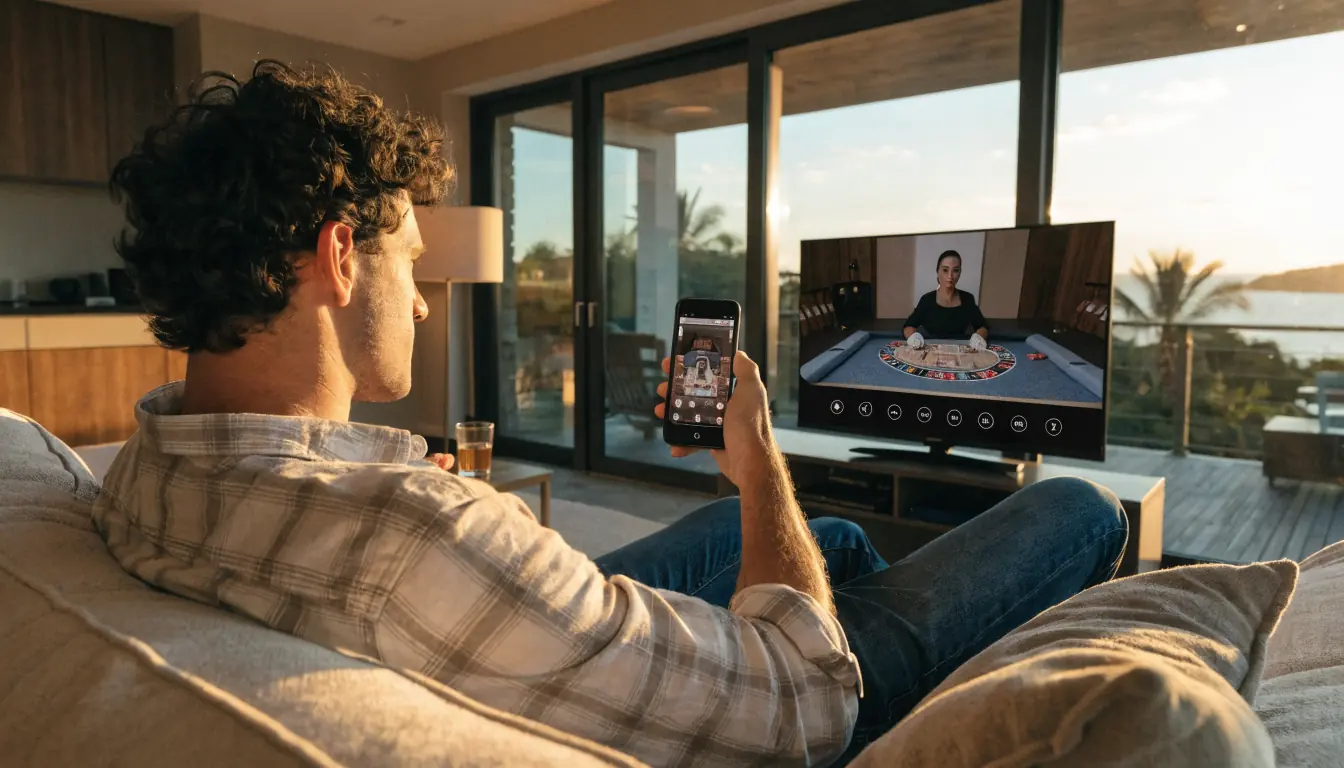
Live dealer tables were originally sold as a desktop product — big screen, stable connection, a proper view of the wheel. That’s not how Australians actually play them anymore. Mobile sessions make up, by one industry estimate, over 70% of all online gambling activity in the country. Live casino has followed the same curve, not led it.
What that means in practice: a live blackjack or roulette table that renders badly on a mid-range Android phone loses the argument before the dealer deals a card, no matter how good the studio looks on a review site’s desktop screenshot. The stream needs to hold up on mobile data, not just office wifi. Chat and bet panels need to be usable with a thumb, not a mouse. None of that shows up in a features list — you only notice it’s missing mid-session, usually right when you’re trying to place a bet before the betting window closes.

What a typical session actually costs
Numbers around deposit behaviour get thrown around loosely, so it’s worth being precise about where they come from. One industry source puts the average monthly deposit among active Australian online casino players at $127, and estimates total Australian online gambling revenue for the year at $7.2 billion. Those are industry-wide figures from a single review, covering all online casino play — not a live-casino-specific number, and not something any individual operator publishes about its own player base.
What that figure is useful for isn’t predicting what any one player will spend — it’s context. Live dealer minimum bets tend to sit above equivalent pokies spins, because studio time and dealer wages cost more per hand than a slot’s random number generator. A session that feels casual on a $5 pokie can burn through a similar bankroll much faster at a live table with a higher table minimum. "Live casino" as a category asks for a bigger per-decision stake than most of the rest of the site, and that’s worth knowing before sitting down, not after the balance is gone.
Withdrawal speed
Even if PayID is fast, operators can delay payouts with verification queues or manual reviews, so expect potential waiting times before the money leaves the casino.
Reading a live casino honestly
None of this — withdrawal speed, mobile behaviour, deposit size — is something a casino’s own "About" page will tell you straight, because none of it is flattering when it’s slow, clunky, or expensive. The honest version comes from watching how a specific operator behaves in each of these three areas, not from taking "24/7 support" or "instant payouts" as settled facts.
A few things worth checking before assuming a live casino experience will hold up:
- What currency actually hits the account — Australian-facing operators in 2026 process deposits and withdrawals in AUD; a site quoting USD balances is already adding a conversion step nobody asked for.
- What “verified” means for withdrawal speed — the fast processing times quoted anywhere are for verified players; an unverified account is playing a different game entirely.
- Whether the mobile site was built or bolted on — a responsive skin over a desktop layout is not the same as a table designed to be played one-handed on a train.
None of that is glamorous. It’s also the part that determines whether the "live casino experience" matches what got advertised, or just what got promised.
Live Casino Software Providers and Free Features
Every live table an Australian player sees runs on somebody else’s infrastructure. The casino brand is just the storefront. Behind it sits a studio operator who built the cameras, the shuffling machines, the dealer training program, and the streaming pipeline — and licenses that whole package to dozens of operators at once. Pragmatic Play and Microgaming are the two names that show up most often across Australian-facing sites, and once you notice their table layouts and dealer uniforms, you start seeing the same studio repeated across brands that otherwise look nothing alike.
This matters more than it sounds like it should, because the software provider — not the casino — is usually the one setting the technical ceiling on what a table can do. Bet limits, camera angles, chat functionality, how many seats a table has: these come from the studio’s build, not from the operator’s marketing team. A casino can slap its logo on the interface, but it can’t change how the underlying feed works.
What "free" actually means here
None of these studios let you deposit real money into a demo table — that’s not how the arrangement works, and it’s not what "free" refers to. What’s actually offered without a deposit:
- Practice or demo modes on select tables — mostly blackjack and roulette variants, run on a delayed or looped feed rather than a live dealer, so a player can learn betting patterns and interface controls before committing funds.
- Free-to-view lobbies — most platforms let a visitor watch a live table, see the dealer, and browse bet limits before registering an account.
- Statistics and history panels — roulette tables in particular often show recent number histories and hot/cold trackers at no cost, a feature built into the studio software rather than something the casino adds.
What isn’t free, regardless of how a promotion is worded, is the game itself once real chips are on the table. I’ve seen "free live casino" used as a headline on pages where the actual offer was a matched deposit — technically not false, but built to be misread. Worth checking the fine print before assuming "free" means no money changes hands anywhere in the process.
Why the provider list is short for Australian players
There’s a structural reason the same handful of studios keep appearing. The Interactive Gambling Act 2001 prohibits Australian companies from operating online casino services for residents of the country, which means every studio and every casino serving this market sits offshore by design, not by choice. It’s not illegal for an individual player to use these offshore-licensed platforms — the law targets the operators, not the person placing a bet — but it does mean the software vendors building for this market are answering to regulators in Curaçao or Malta, not Canberra. Nothing here is locally certified, because there’s no domestic licence to certify it against.
Offshore risk
All Australian live‑casino providers operate offshore, meaning they are not regulated by Australian authorities and player protection relies on foreign licences.
That offshore structure is also why studio reputation ends up doing work that regulation would otherwise do. A provider with years of uptime across multiple jurisdictions has more to lose from a rigged shuffle or a lagging feed than a studio nobody’s heard of. It’s not a substitute for oversight, but it’s the closest proxy available.
What the provider’s build should tell you before you sit down
Before joining a table, the provider layer is worth a quick check — not the casino’s promotional copy, the actual software behind it:
- Table variety and seat limits — some studios cap seats tightly to keep dealer interaction personal; others run high-volume tables where you’re one of dozens watching the same feed.
- Bet range transparency — minimum and maximum bets are set by the software provider, and they should be visible before you’re logged in, not revealed only after a deposit clears.
- Currency handling — AUD support is a studio-level feature, not something a casino can bolt on afterward. A platform without native AUD support usually means a conversion fee sitting quietly inside every transaction.
None of this is exotic due diligence. It’s the same checklist I’d have run through on the operator side, just aimed the other way.
Signs the provider — or the casino wrapping it — isn’t worth the seat
A handful of patterns keep showing up on the platforms worth avoiding, and they tend to cluster together:
- Wagering requirements sitting at 60x or higher on welcome offers, buried past the headline number.
- Withdrawal processing that stretches past five days with no clear explanation.
- No AUD support, meaning every deposit and withdrawal quietly loses value to conversion fees.
- A pokies catalogue under 500 titles — often a sign the operator hasn’t licensed a serious spread of studios at all, live or otherwise.
- Bonus terms that read fine in the promotional email and turn hostile in the terms page.
- No PayID or other Australian-native payment rail on offer.
None of these are live-dealer-specific problems, but they’re usually visible before you ever click into a table — which makes them the cheapest checks to run first.
Live Casino Poker Options and How They Differ
Live poker sits apart from everything else on the table games menu. Roulette runs on a wheel and a ball that don’t care who’s watching. Poker runs on decisions — yours, the dealer’s pace, and the structure of the game itself. That changes how the whole thing feels to play, and it changes what a platform actually has to get right.
Most Australian live casino platforms offer poker in a handful of fixed formats: Casino Hold’em, Three Card Poker, Caribbean Stud, and occasionally Ultimate Texas Hold’em. These aren’t peer-to-peer poker rooms — nobody is bluffing a stranger across the felt. You’re playing against the house, with the dealer running a scripted set of rules that never bends. That’s a meaningful distinction, because it means the "poker" experience here has more in common with blackjack than with a tournament final table. Anyone expecting multi-table cash games or live poker tours is looking in the wrong section of the site.
Dealer interaction, and its limits
The dealer’s role in poker variants is narrower than in roulette or blackjack. There’s less banter, because the structure demands more procedural precision — cards get dealt, hands get compared, side bets get resolved, and the pace rarely slows down for chat. Some studios build in a fold/raise decision window with a countdown timer, and the dealer waits it out in silence rather than filling the space with conversation. I’ve noticed that players who came in expecting a social table game are often the ones who leave fastest — the format just isn’t built for it the way European Roulette or a chatty blackjack table is.


Where dealers do add value is in transparency. Card reveals happen on camera, in real time, with no way to review a hidden shuffle after the fact. That’s the entire pitch of "live" poker versus its RNG equivalent: you watch the deck get handled rather than trusting a certified algorithm you’ll never see. Whether that matters to a given player is a matter of taste. It doesn’t change the odds.
Payment considerations specific to poker tables
Poker variants tend to involve more side bets and ante structures than a single roulette spin, which means more individual transactions hitting the account ledger over a session. That’s not a payments problem on its own, but it interacts with a real one: Australia’s major banks can and do block transactions headed to gambling operators, including deposits meant for a poker table that never gets past the bank’s own filter. It has nothing to do with the casino’s payment processor and everything to do with how the sending bank flags the transaction.
Players running into this at poker tables specifically — where a session might involve several buy-ins rather than one deposit — tend to notice it faster than a slots player making a single deposit and walking away. A blocked transaction mid-session doesn’t just delay play, it can strand a hand in progress. Worth knowing before sitting down, not after.
None of this is unique to poker in principle. But because poker sessions are structured around discrete betting rounds rather than continuous spins, payment friction shows up more visibly here than at a roulette wheel or a slot reel. "Seamless payments" is a phrase every operator uses in its marketing. What it actually means, in practice, is whether your bank lets the transaction through at all — and that’s decided well before the platform ever sees it.

Popular Live Casino Games and Their RTP Profiles
Table games get the marketing budget, but pokies are what most players actually open first. That’s not an opinion — it’s what shows up when you watch a lobby fill up on a Friday night. The live-streamed roulette wheel and the poker tables sit lower down the page for a reason. Volume goes to slots.
RTP is the number that matters most here, and it gets misquoted constantly. "Up to 98% RTP" on a banner usually means one specific game, on one specific network, under conditions the fine print doesn’t spell out. The honest range for real money pokies rated well by Australian players sits between 95% and 97%. Anything advertised well above that on the front page and buried in disclaimers is worth double-checking before it’s worth trusting.
What players are actually loading up
A handful of titles keep reappearing across Australian-facing platforms, for different reasons:
- Book of Dead — RTP of 96.21%, a fixed number rather than a range, which is rarer than it should be in this industry. Egyptian theme, expanding symbol mechanic, nothing unusual about the format itself.
- Sweet Bonanza — a cluster-pay title with a loyal following, though its RTP isn’t published with the same clarity as Book of Dead’s. Worth checking the in-game paytable directly rather than trusting a summary page.
- Lightning Link — high volatility. Long stretches of nothing, then a jump. This is the “infrequent but large” end of the spectrum, and it plays like it.
- Dragon Link — sits in similar territory to Lightning Link, sold on the same feature-heavy, big-swing appeal.
- Buffalo Slots — a lower-volatility option by comparison, steadier and less punishing between wins.
- Mega Moolah — the progressive jackpot pokie most people have at least heard of, even if they’ve never spun it.
Volatility isn’t a footnote
It gets treated like a side detail. It shouldn’t be. Two pokies can carry near-identical RTP figures and feel completely different to sit through. High-volatility games — Lightning Link is the clearest example — go quiet for long periods and then release a large win. Low-volatility games spread smaller wins more evenly across a session, so the balance moves less dramatically in either direction.
Neither is "better." One suits a player with a fixed budget and a short session. The other suits someone happy to let a bankroll swing hard in exchange for a shot at a bigger payout. Choosing between them without knowing which one you’re picking is how sessions end faster than expected.
Beyond pokies
Blackjack and baccarat variants sit around the room too, usually with RTP figures tighter and less variable than slots, since the math behind card games leaves less room for design flourishes. Game show formats — the wheel-spin, prize-multiplier style titles — trade RTP precision for entertainment value; they’re built to be watched as much as played, and the return figures on these tend to be harder to pin down than a straightforward pokie’s paytable.
None of this replaces checking the specific game’s payout information before betting real money. A catalogue tells you what’s popular. It doesn’t tell you what a given studio has quietly rebalanced in the last update. That check takes thirty seconds and it’s the difference between playing something you understand and something you assumed.
Live Roulette: Top Sites and What Sets Them Apart
Live casino tables live or die on how fast you can fund them, cash out, and actually claim the welcome offer, so it’s worth checking the fine print before picking where to play in 2026.
Bonus: up to A$750 + 50 jackpot spins, 35x wagering · Payout speed: crypto ~90 minutes, fiat 1-5 days · Min. deposit: A$30 Kingmaker pairs a bonus of up to A$750 plus 50 jackpot spins with quick crypto payouts (around 90 minutes) and a low A$30 minimum deposit, making it accessible for smaller bankrolls.
License: Curacao Gaming Control Board OGL/2023/174/0082 (Dama N.V.) · Bonus: up to A$5,000 + 300 free spins across 4 deposits SpinsUp operates under a Curacao Gaming Control Board licence and spreads a large welcome package of up to A$5,000 plus 300 free spins across four deposits, rewarding players who fund their account multiple times.
License: Curacao Gaming Control Board OGL/2023/176/0095 (Hollycorn N.V.) · Bonus: up to A$11,000 + 300 free spins (code NEO100) Neospin holds a Curacao Gaming Control Board licence and offers one of the larger welcome bonuses on this list, up to A$11,000 plus 300 free spins, unlockable with a bonus code.
License: Curacao Gaming Control Board OGL/2023/176/0095 (Hollycorn N.V.) · Bonus: 100% up to A$10,000 + 100 free spins GoldenCrown is Curacao Gaming Control Board licensed and backs a straightforward 100% match bonus up to A$10,000 with 100 free spins.
Bonus: up to A$7,500 + 550 free spins across 10 deposits, 50x wagering · Payout speed: crypto under 1 hour, PayID 1-3 business days · Min. deposit: A$20 (A$30 to qualify for the bonus) Ricky Casino stands out for its payout speed, with crypto withdrawals processed in under an hour and PayID within a few business days, plus a sizeable multi-deposit bonus of up to A$7,500 and 550 free spins.
License: Curacao Gaming Control Board (TechSolutions Group N.V.) · Bonus: 100% up to A$250 + 100 free spins (1st deposit) Bizzo Casino is licensed by the Curacao Gaming Control Board and offers a modest, straightforward first-deposit bonus of 100% up to A$250 with 100 free spins.
License: Curacao eGaming (Roby Games Ltd) · Bonus: 100% up to A$750 + 200 free spins Roby Casino holds a Curacao eGaming licence and offers a 100% welcome bonus up to A$750 with 200 free spins.
License: Curacao eGaming (Dama N.V.) · Bonus: up to A$10,000 + 180 free spins, 40x wagering JeetCity Casino is Curacao eGaming licensed and offers a generous welcome bonus of up to A$10,000 with 180 free spins.
Bonus: 100% up to A$750 + 200 free spins, 35x wagering · Payout speed: crypto 30-120 minutes, fiat 24-72 hours · Min. deposit: A$30 MrPacho combines a 100% bonus up to A$750 with 200 free spins and notably fast crypto withdrawals, alongside a low A$30 minimum deposit for easy entry.
License: Curacao OGL/2024/1335/0780 · Bonus: up to A$1,000 + 150 free spins, wager-free · Min. deposit: EUR 20 Vegaz Casino, licensed under Curacao’s OGL framework, offers a wager-free bonus up to A$1,000 with 150 free spins, appealing to players who prefer fewer strings attached to their bonus.
Ranking live roulette platforms properly means sitting through the same wheel long enough to notice what actually differs between operators. It’s rarely the game itself — the wheel is the wheel, the physics don’t change. What changes is everything around it: how fast the dealer spins, how wide the betting limits stretch, and whether the table feels designed for someone with $20 or someone with $2,000.
What actually separates one live roulette table from another
Dealer pace. Some tables run a fast rhythm — spin, close bets, result, next spin — built for players who want volume. Others run slower, with more chat, more time between rounds. Neither is "better," but they suit different sessions. A player putting in a quick 20 minutes on a break wants speed. Someone treating it as an evening’s entertainment wants the slower table.
Betting range. This is where operators actually compete. A platform offering only high minimums shuts out casual players; one with no upper ceiling attracts a different crowd entirely. The spread of tables — low-stakes alongside high-limit rooms — says more about who a site is built for than any marketing copy does.
Offers a wide range of live tables with solid camera angles and consistent AUD support.
Provides high‑quality streams and a strong reputation for reliable payouts.
Sets the industry standard for immersive live dealer experiences and extensive game variety.
Table variety. European, French, and speed roulette variants aren’t interchangeable. French tables typically carry rules that reduce losses on even-money bets in specific scenarios; speed variants strip out betting time to push more spins per hour. A site listing "live roulette" without specifying which variant is available is telling you it hasn’t thought much about the format.
Stream quality and camera angles. Multiple camera angles on the wheel, a clear view of the ball drop, minimal lag between the physical spin and the digital bet confirmation — these matter more once real money is on the table than they do in a demo. A half-second delay doesn’t sound like much until a bet locks a moment before you meant to place it.
Reading a roulette lobby honestly
I’ve sat through single sessions of "over 70% of a site’s tables" — a phrase I stopped trusting once I actually counted duplicated feeds. Some lobbies inflate table counts by running the same wheel through several camera presets, listing each as a separate game. Worth checking the provider name and studio on each table before assuming variety. If five "different" roulette tables all lead to the same dealer and same wheel, the count is decoration, not choice.

The honest way to compare sites isn’t studio branding — it’s watching a session end to end: how long from bet close to payout, whether the chat moderation feels present or ignored, whether the betting limits actually match what’s advertised on the lobby card.
None of this is a huge time investment. Regular Australian players spend an average of 2.3 hours a week on online pokies, according to industry tracking — roulette sessions tend to run shorter, which makes the first few minutes at a table more telling than they’d be on a slot. There’s less noise to hide behind.
Short version: the wheel doesn’t change. Everything around it does.
Live Dealers: How They Operate and Player Interaction
The dealer at a live table is running a physical game — shuffling, spinning, dealing — inside a studio built specifically for cameras, not for a room full of people. Most of these studios sit outside Australia entirely, since no local licence covers this kind of operation here. The tables are real, the cards are real, but everything around them is engineered for broadcast: fixed camera rigs above the wheel or shoe, a second angle on the dealer’s hands, sometimes a third on the whole table for context.

What makes it "live" rather than a video loop is the sync between the dealer’s physical action and the software layer sitting on top. A card gets dealt, and within a second or two the system reads it — usually through a small sensor or barcode on the card itself — and updates every connected screen at once. Roulette wheels work the same way: a tracking system reads where the ball lands and feeds that result into the betting engine faster than any human could type it in.
Talking to a dealer who can’t talk back to everyone
Communication runs one direction more than players expect. The dealer can see a chat feed and usually responds to it out loud, but the audio only goes one way — from the dealer’s microphone to the players, not the other way around. Players type; the dealer reads and reacts on camera. It works well enough for a quick "good luck" or a question about the rules, less well for anything that needs a fast answer, since the dealer is also running the game and managing multiple players typing at once.
Dealers rotate on fixed shifts, and the pace of a table is set by the software timer, not by the dealer’s discretion. That’s worth knowing because it explains why a table sometimes feels rushed near the betting cutoff — the countdown is fixed, and the dealer has no authority to extend it for one player who’s still deciding.
Where dealer interaction changes between game types
Blackjack tables generally have the most back-and-forth, since decisions happen one player at a time and there’s a natural pause for banter. Baccarat-style games, including Dragon Tiger, move faster and involve less exchange — the round is short enough that there isn’t much room for conversation beyond a greeting. Roulette sits in between: the spin gives a short window where chat is active before the wheel takes over.
None of this changes the odds or the outcome. The interaction layer is a comfort feature, not a mechanical one — worth remembering before treating a friendly dealer as any kind of guide to strategy. The camera, the sensor, the timer: those decide the round. The chat is just conversation running alongside it.
Mobile is now the default platform for Australian players; a live table must perform well on mid‑range Android and iOS devices to stay competitive.
Live Casino Availability in the USA
The US market runs on a completely different logic than the Australian one, and it’s worth spelling out why, because the two get lumped together in comparison articles that don’t hold up on closer reading.
There’s no federal framework equivalent to the Interactive Gambling Act. Instead, each state decides for itself whether online casino products — live dealer tables included — can be licensed within its borders. A handful of states run regulated real-money online casinos with in-state live dealer studios. Most states don’t offer anything of the sort, and residents there have no legal domestic option at all.
That patchwork matters for anyone trying to compare "the US" to "Australia" as if both were single markets. Australia has one national prohibition on operators and a grey zone for players using offshore sites. The US has neither one national rule nor one grey zone — it has fifty different answers, several of which contradict each other depending on which side of a state line a player happens to be standing on.
Offshore operators do serve US players in states without regulated products, in a legal position that’s murkier than the Australian offshore arrangement — enforcement there targets operators far more aggressively than it does in Australia, and payment processing for US customers is generally harder, slower, and more restricted.

None of this is Australian regulation, and none of it should be read as guidance for an Australian player. The point of mentioning it at all is to stop a common mix-up: bonus terms, table limits, or provider lineups advertised for US live casino products don’t transfer to what’s available — or legal — for someone playing from Australia. A "live casino bonus" seen on a US-facing site tells you nothing about what an offshore operator will actually offer an Australian account.
Two markets, two rulebooks. Worth remembering before comparing screenshots.
How to Play Live Casino Games Safely
Age verification is the first checkpoint, and it’s not negotiable. The minimum age to play at online casinos in Australia is 18. Every operator worth using asks for identity documents before a withdrawal goes through, and that’s not the site being difficult — it’s the one piece of compliance that actually protects the person on the other end of the connection. I’ve seen accounts frozen mid-session because a birth date didn’t match a driver’s licence. Frustrating in the moment, correct in principle.
Connection security matters more with live tables than with anything else on a casino site, because the stream, the chat, and the payment session are all running at once. A few habits carry more weight than people expect:
- Play on a private network, not public Wi-Fi — a live dealer session carries video, chat and financial data simultaneously.
- Check the browser padlock before entering any payment details, every session, not just the first time.
- Log out properly rather than closing the tab, especially on a shared or borrowed device.
- Keep session length in view. Live tables run continuously, and there’s no natural pause the way there is between pokie spins.
That last point is the one people underestimate. A live blackjack or roulette table doesn’t stop for you — the dealer keeps dealing whether you’re tracking time or not. Setting a deposit limit or a time limit before joining a table does the job that willpower usually can’t, once a shoe is running well or badly.
"Responsible gambling" gets printed at the bottom of every page and rarely gets explained. In practice it means three things: play within a budget set before logging in, verify identity honestly the first time so withdrawals aren’t delayed later, and step away when a session stops being a session and starts being a habit. None of that is exciting to write. It’s also the only part of this that actually protects the player rather than the operator.
Live Casino Mobile Apps: Top Picks for 2026
Most operators stopped building native apps years ago. What they call an "app" is usually a browser shell — a wrapper around the same mobile site, sometimes with a home-screen icon and push notifications bolted on. That’s not a criticism, just how the plumbing works: app store rules on gambling content are strict enough that a progressive web app is the path of least resistance for most brands.
Seamless AUD handling
Operators that natively use AUD avoid hidden conversion fees, giving players a clearer cost structure and faster withdrawals.
For live tables specifically, this matters more than it does for pokies. A native shell can crash on a background refresh mid-hand. A well-built web app tends to hold the video stream steadier, because it’s not fighting the OS for memory the way a heavier native install does.
What actually separates a good one from a bad one
- Reconnection handling. Drop the connection during a live blackjack hand and a decent app rejoins where you left off. A bad one boots you to the lobby.
- Payment flow inside the app, not a redirect to a browser. Cashier pages that bounce out to Safari or Chrome and back are where deposits get abandoned half-finished.
- AUD as the native currency, not USD with a conversion step at checkout. Australian operators in 2026 run AUD balances by default — anything asking to confirm a currency conversion at the cashier is worth a second look.
- Table filtering that works on a small screen. Scrolling through forty roulette variants on a 6-inch display is a UX failure, not a feature.
None of this shows up in a screenshot on a review page. It shows up when the stream buffers at 2am on mobile data and the app either recovers gracefully or doesn’t.
The install itself tells you little. What tells you something is whether the cashier, the video feed and the bet panel all sit inside one continuous session — no tab-switching, no re-authentication halfway through a shoe. That’s the actual test, and it’s one most "top app" lists skip because it takes longer than checking if the icon looks nice.
Live Casino Landscape in Australia: Regulations and Payments
No Australian regulator issues licences for online casino games, live dealer tables included. The Interactive Gambling Act 2001 targets operators, not the people placing bets, which is why the sites Australians actually use are licensed offshore. That’s the legal reality behind every live table you’ll see this year — not a footnote, the whole picture.

What’s left for players to check isn’t a licence register — there isn’t one — but the technical and payment layer underneath it.
On encryption, the better-run platforms use 256-bit SSL across the site, live streams included. That’s the same grade banks use. Worth confirming before you send a deposit, not after.
On payments, banks in Australia can and do block transfers to gambling sites. PayID and crypto route around that block, which is the practical reason both have become the default rather than a convenience feature. Bank transfer still works when it works. It just doesn’t always.
Put together: no domestic licence to look for, encryption you can verify yourself, and a payment method chosen for what it avoids, not just what it offers.
Can I play on an Australian online casino on mobile?
Yes — mobile is the default way Australians play, accounting for over 70% of all online gambling sessions. Check that the live tables were built for one-handed play rather than bolted on as a desktop skin, and that the stream holds up on mobile data.
What law governs online gambling in Australia?
The Interactive Gambling Act 2001, which prohibits Australian companies from offering online casino services to residents. It is not, however, illegal for individual Australian players to gamble at offshore-licensed casinos.
Is online gambling legal in Australia?
Australian-licensed online casinos cannot legally serve residents under the Interactive Gambling Act 2001, but individual players are not breaking the law by using offshore-licensed casinos. You must be at least 18 to play.
What are the common responsible-gaming utilities offered by reputable online casinos?
Yes — top platforms use 256-bit SSL encryption and support fast AUD withdrawals via PayID or crypto, which also bypass bank blocks on gambling transactions. Look for deposit and wagering terms stated plainly rather than buried in fine print.